

Our Blood is Not Cheap
Welcome to the digital showcase of our community art competition. This exhibition honors collective memory, dignity, and resistance through the work of local artists. Each piece selected reflects our refusal to be reduced to numbers and our commitment to preserving story through art.
Visitors are invited to view all submitted works and cast their vote for the Community Choice Award. In addition to the public vote, a panel of judges will select 1st, 2nd, and 3rd place winners, with awards presented to support and uplift participating artists.
Thank you for taking the time to engage with this work. Your vote and support help sustain local artists and strengthen our creative community.
You can vote by clicking here or scroll below. Vote ends on March 21.
The Land Remembers By
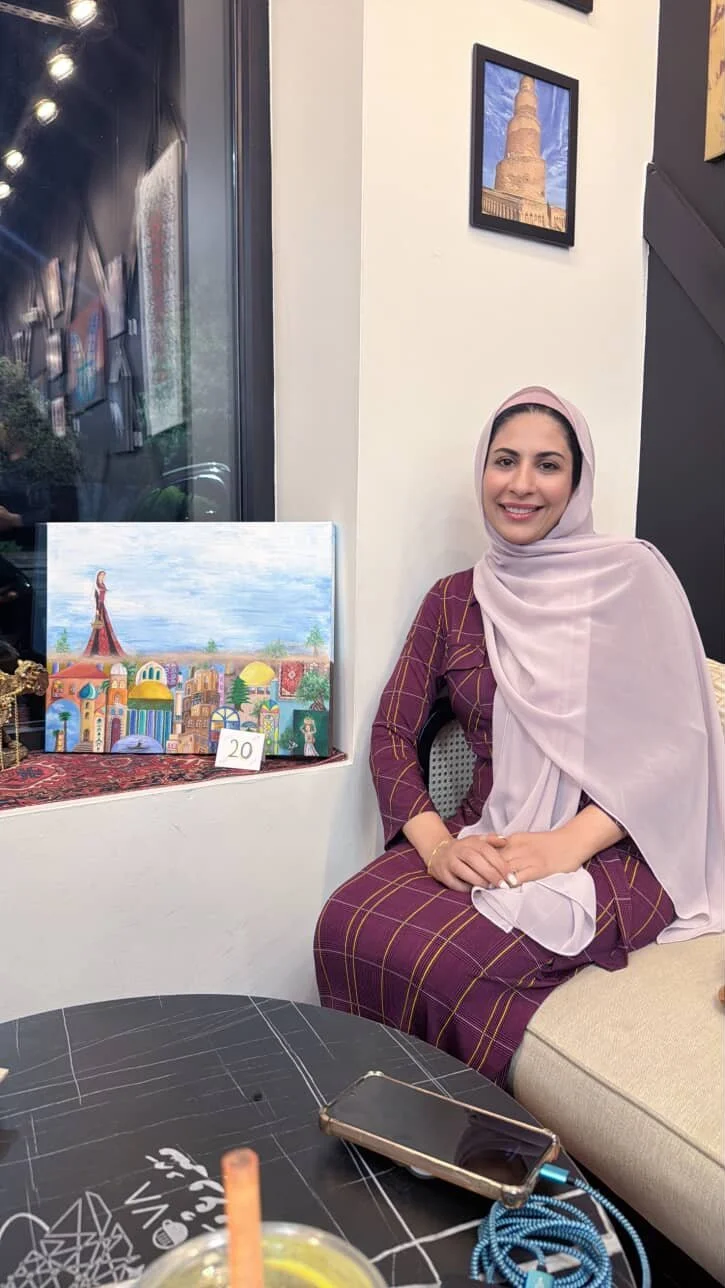
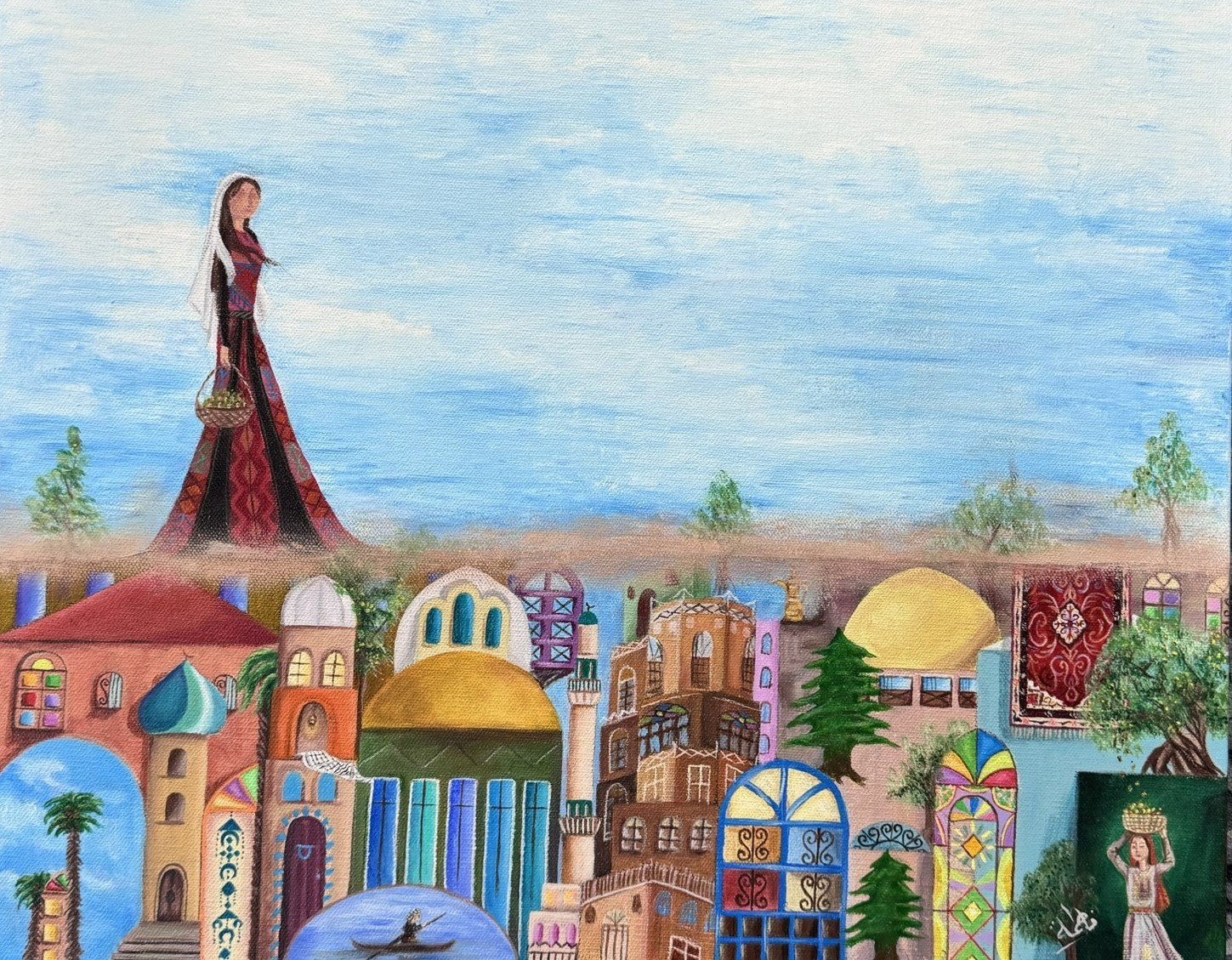
Fatima Alzeheri
This acrylic painting honors those whose sacrifices are woven into the soil of their homelands. The composition unfolds in two realms: above, a Palestinian woman moves beneath an open sky, embodying dignity, endurance, and quiet strength. Below the surface, a tapestry of cultural memory rises—domes, olive trees, patterned windows, and traditional garments—symbols of a heritage deeply rooted and impossible to erase.
The Land Remembers speaks to continuity. Even when lives are lost and structures fall, the roots endure. The land carries memory, and its spirit, like its people, persists beyond any force that seeks to uproot it.
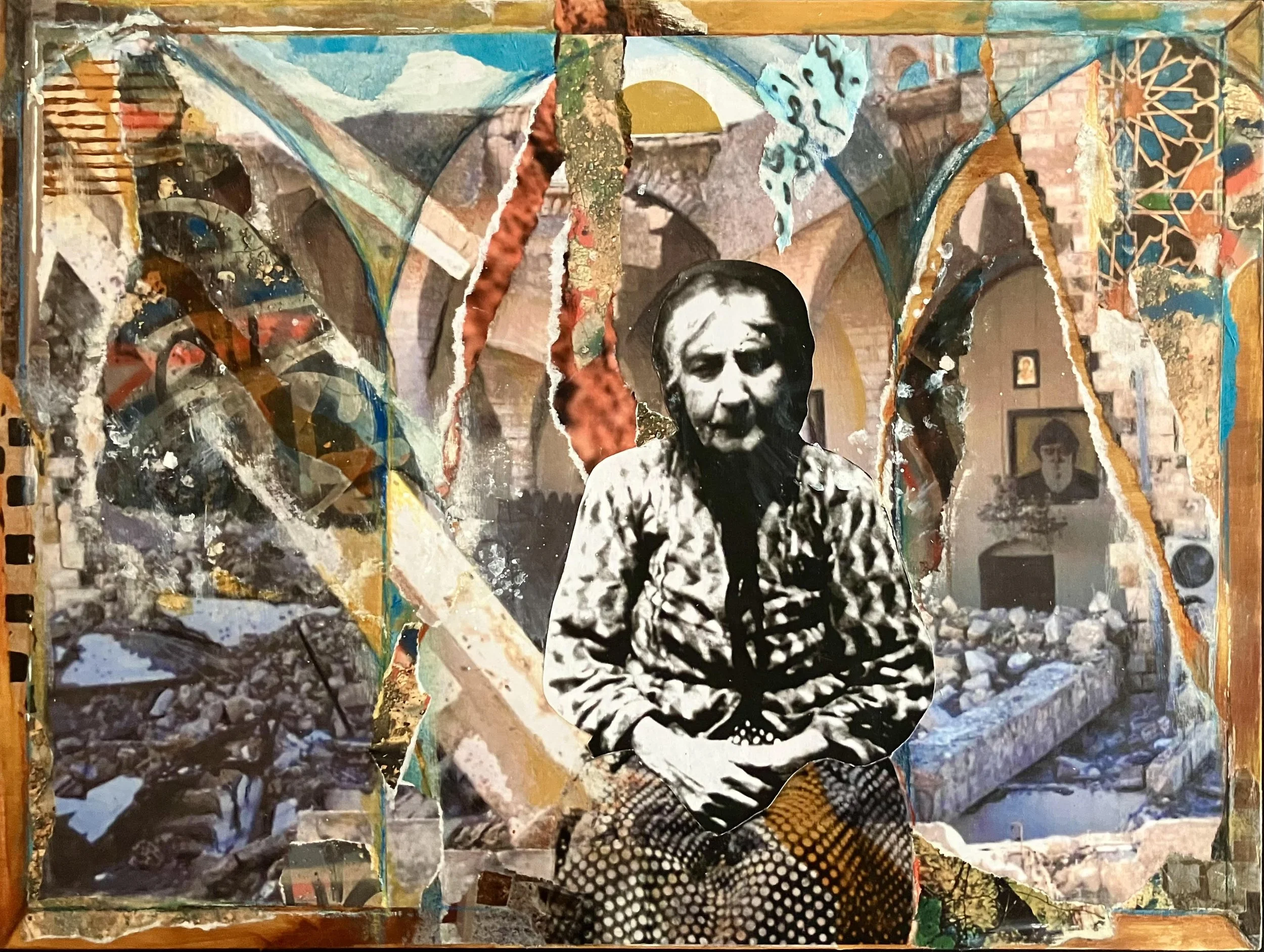
Maryam’s Village by Jarie Ruddy
Using a photo of my great-grandmother from 1958 against a recent image of the ruins of the historic church in our village in South Lebanon, this collage seeks to express the courage and unwavering resilience of the Lebanese people in the face of ongoing adversity. The church was a target of an Israeli strike in October, 2024, which killed eight people who were sheltering there. Some background images are courtesy of photojournalist Ayman Oghanna, used with permission.
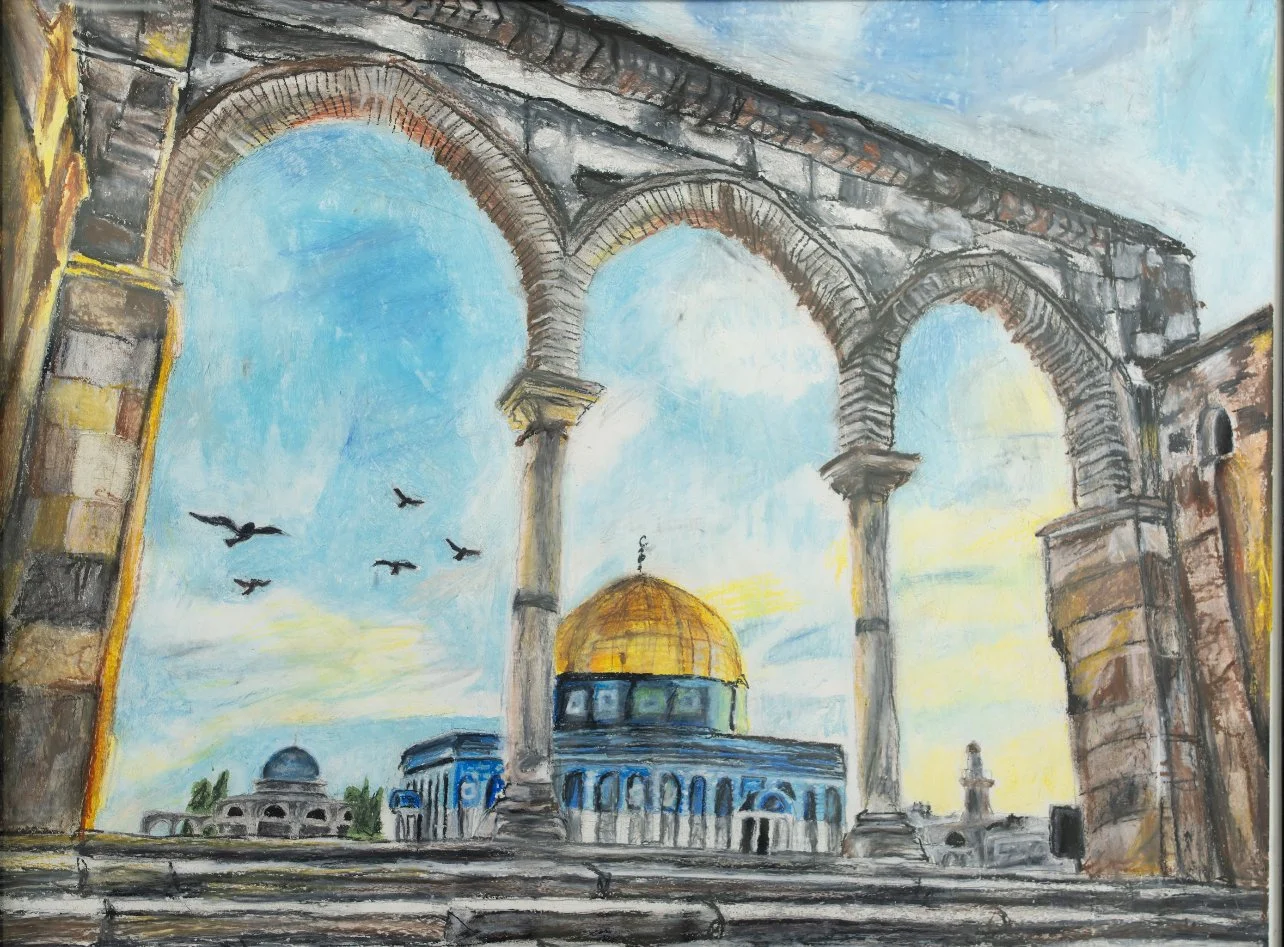
Al Aqsa by Nesreen Husseini
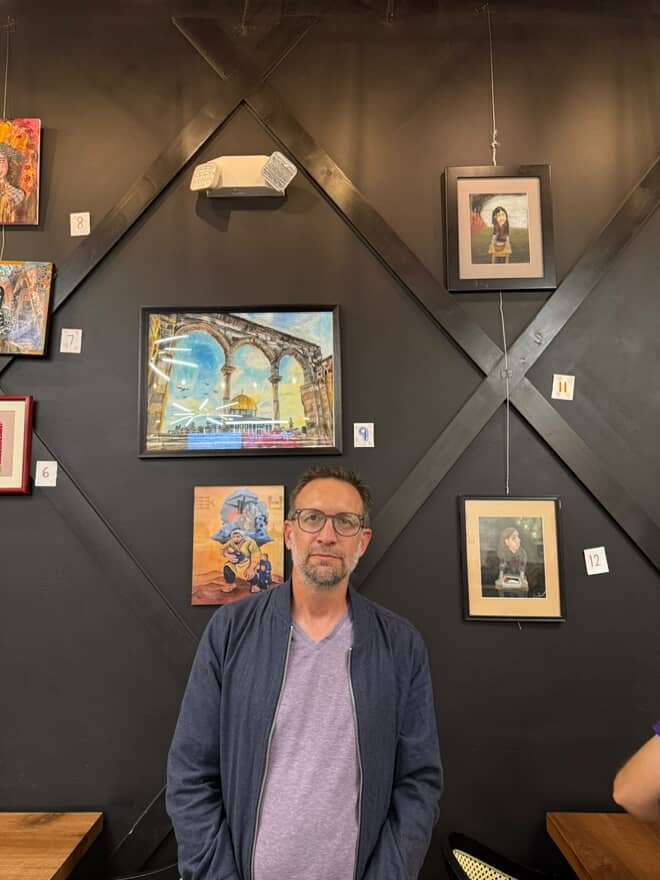
This piece centers the Al-Aqsa Mosque, a sacred and enduring symbol of Arab resistance and cultural identity. Al-Aqsa is more than a place of worship, for many it represents freedom, resistance, and the deep connection people have to their land and heritage. Using oil pastels, I aimed to express the emotions of hope and longing to go back to where home is. I wanted to speak on the remarkable strength a place can have, and when the people of that place hold on to that strength . Al-Aqsa remind us that not all forms are of resistance are loud, Sometimes, it simply stands.
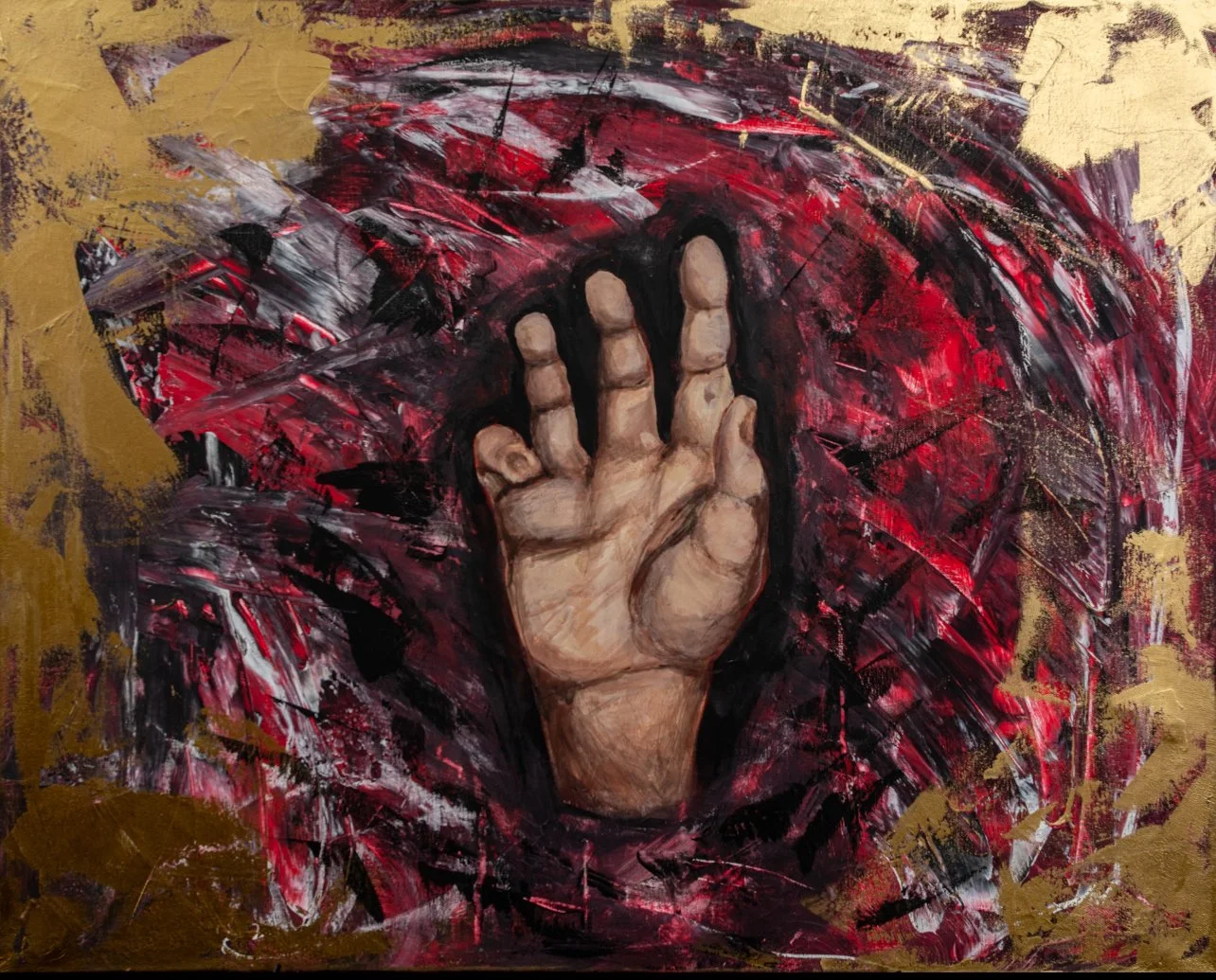
From the Rubble by Nesreen Husseini
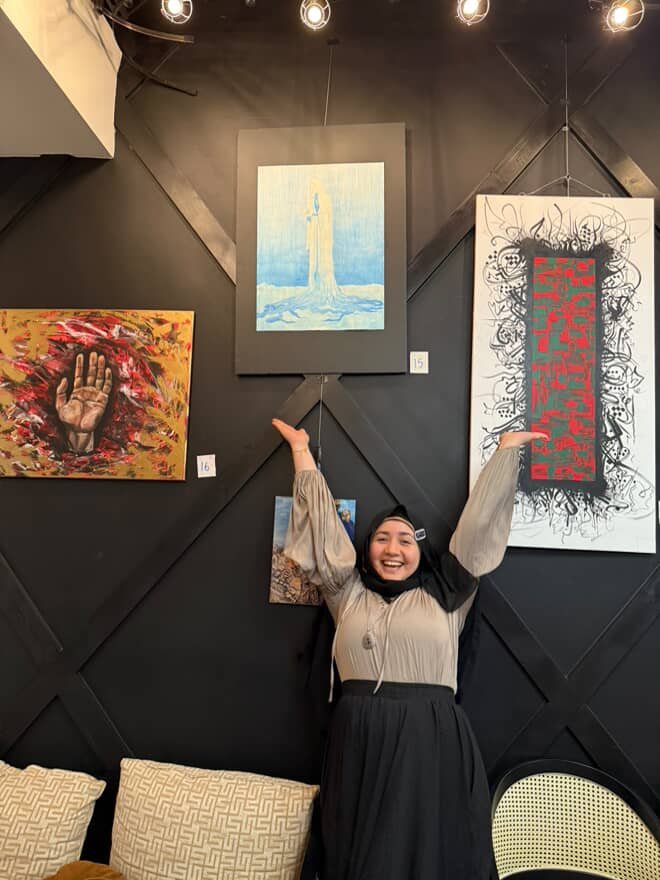
This piece is about being trapped in a reality you cannot escape, it’s about the feeling of being the watcher of a desperate plea. It’s a plea for the world and humanity, for people to wake up and see what the reality of the situation. It’s meant to represent war and the humanity that is forgotten about in politics. Using acrylic paint I aimed to express the feeling of chaos and urgency. I wanted to show the snapshot of history that is denied in media. Showing what the war is taking from our people and the truth that’s been hidden and distorted. The deep reds and blacks shows the destruction and chaos, hidden. This hand is reaching for help from an abstract form of fire. And the gold surrounding is a form of hope shining light on the restricted images.
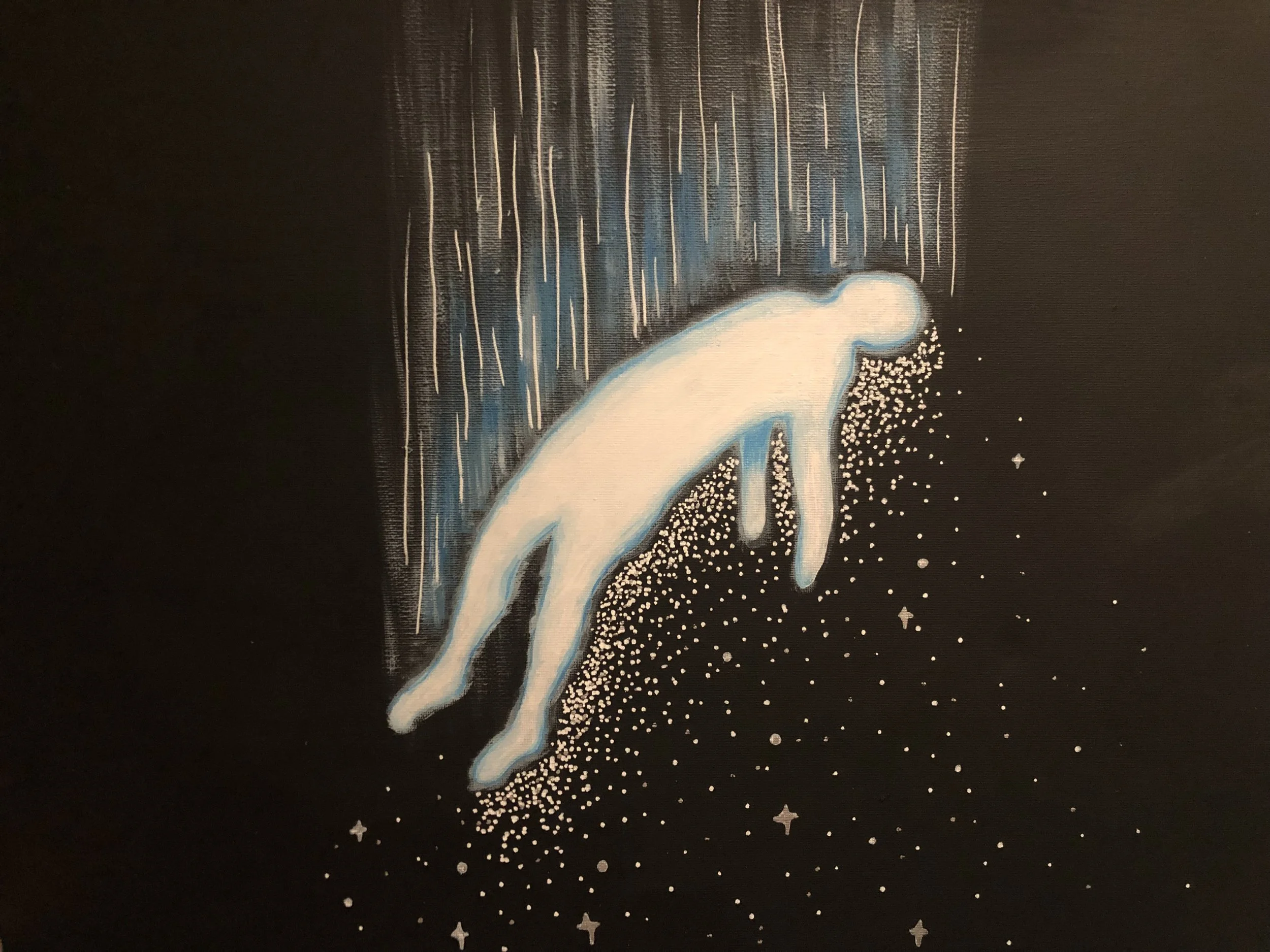
Bountiful Beauty by Amar Haider
This piece represents all of the souls that were martyred in Lebanon and else where, including one of my family members. His name was Jawad. Although I didn’t know him well, everyone spoke about him as if he was the embodiment of “Noor” (light). I knew his whole family, I just never met him. Knowing his story after he passed, made me reminisce of what could have been. This piece is for Jawad, the Bountiful. Allah yerhamo.
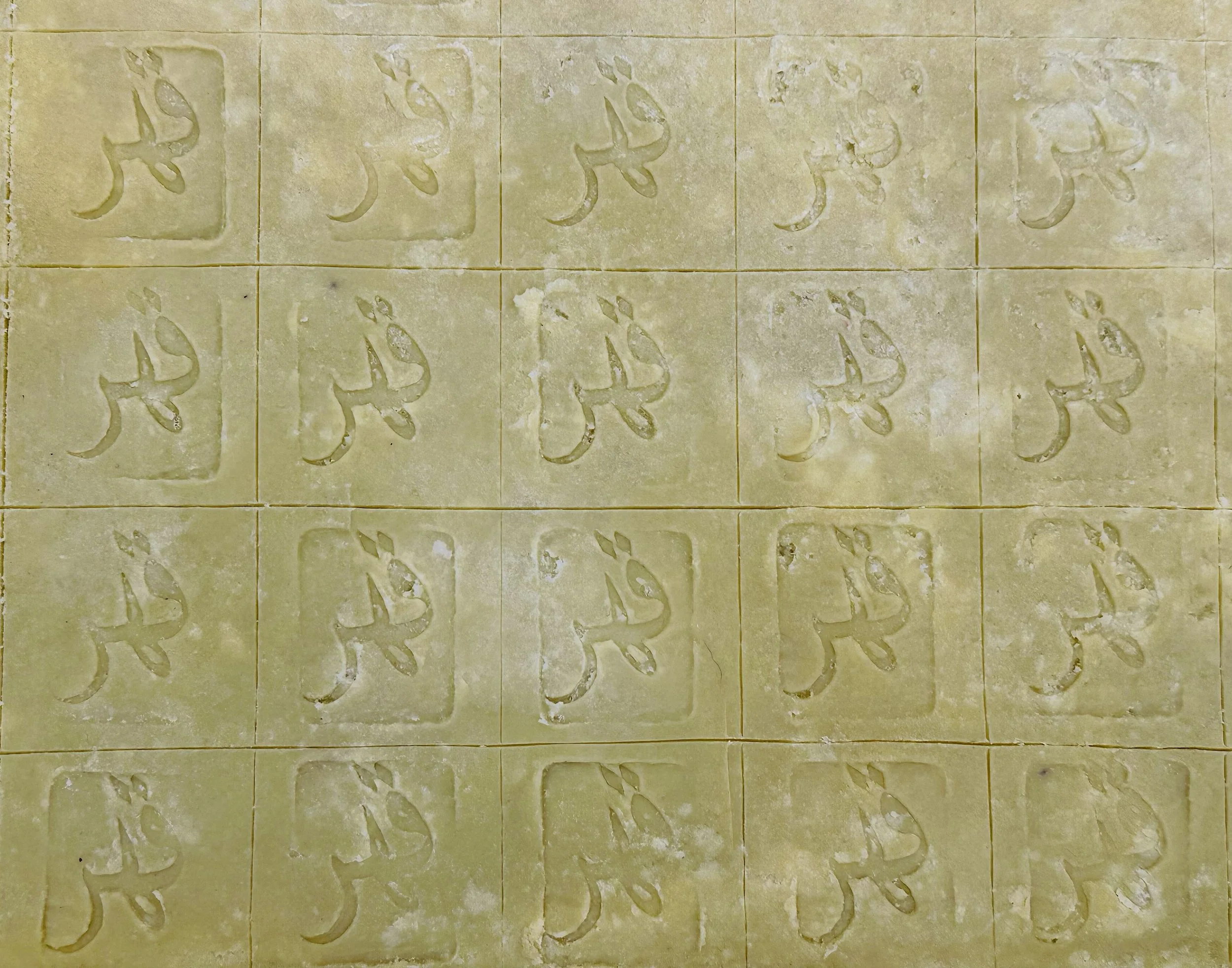
qahr by Manal Shoukair
“My work investigates the quiet forms of resistance found in domestic rituals, ancestral knowledge, and material memory. In my current project, I engage the traditional process of olive oil soap making within the SWANA region. Not only as a craft, but as a site of resilience, tenderness, and inherited dignity. I pour raw soap into a floor bound wooden frame, allowing the mixture to cure slowly in the space. As it hardens, its scent lingers, its surface cracks marking time, presence, and the residue of care. The surface is repeatedly imprinted with the Arabic word qahr (قهر) . A word dense with layered meanings; anger, oppression, endurance. Spiritually, qahr is rooted in al-Qahhār (ٱلْقَهَّار), one of the 99 names of God. The Subduer, The Overwhelming One. It speaks to a divine force that breaks, humbles, and dissolves false power. Each stamp marks a tension between presence and erasure. The impressions threaten to vanish, dissolve, or be overwritten, yet they remain embedded in the material like scars in collective memory. The act becomes both a ritual of mourning and a spiritual invocation: to witness what has been repressed, to subdue what harms, to endure through what remains.The fragility of the soap, easily marred, easily lost contrasts its historical and spiritual weight. It becomes a symbol for the body, for land, for memory; vulnerable yet saturated with meaning. This material gesture becomes one of quiet resistance, echoing cycles of displacement and the divine capacity to both dismantle and renew.”
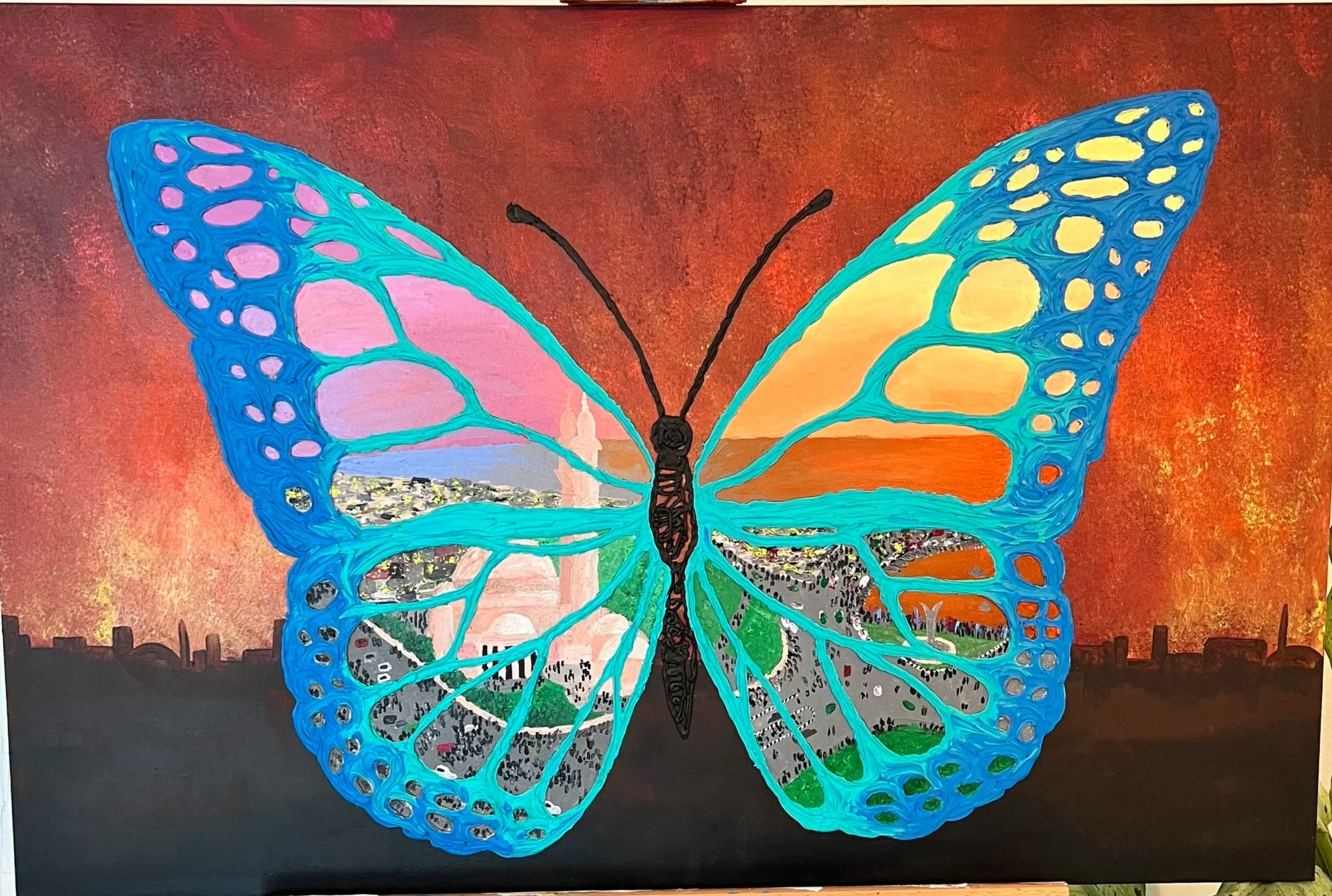
The witness and justifier by Aicha Kabbara
”It is a painting with the bombings of Gaza and a huge butterfly on top of it. Inside the butterfly is painted how beautiful Gaza was before the genocide, indicating that even as small as a butterfly will be a witness to what was and will justify to what is on the day of judgement.”
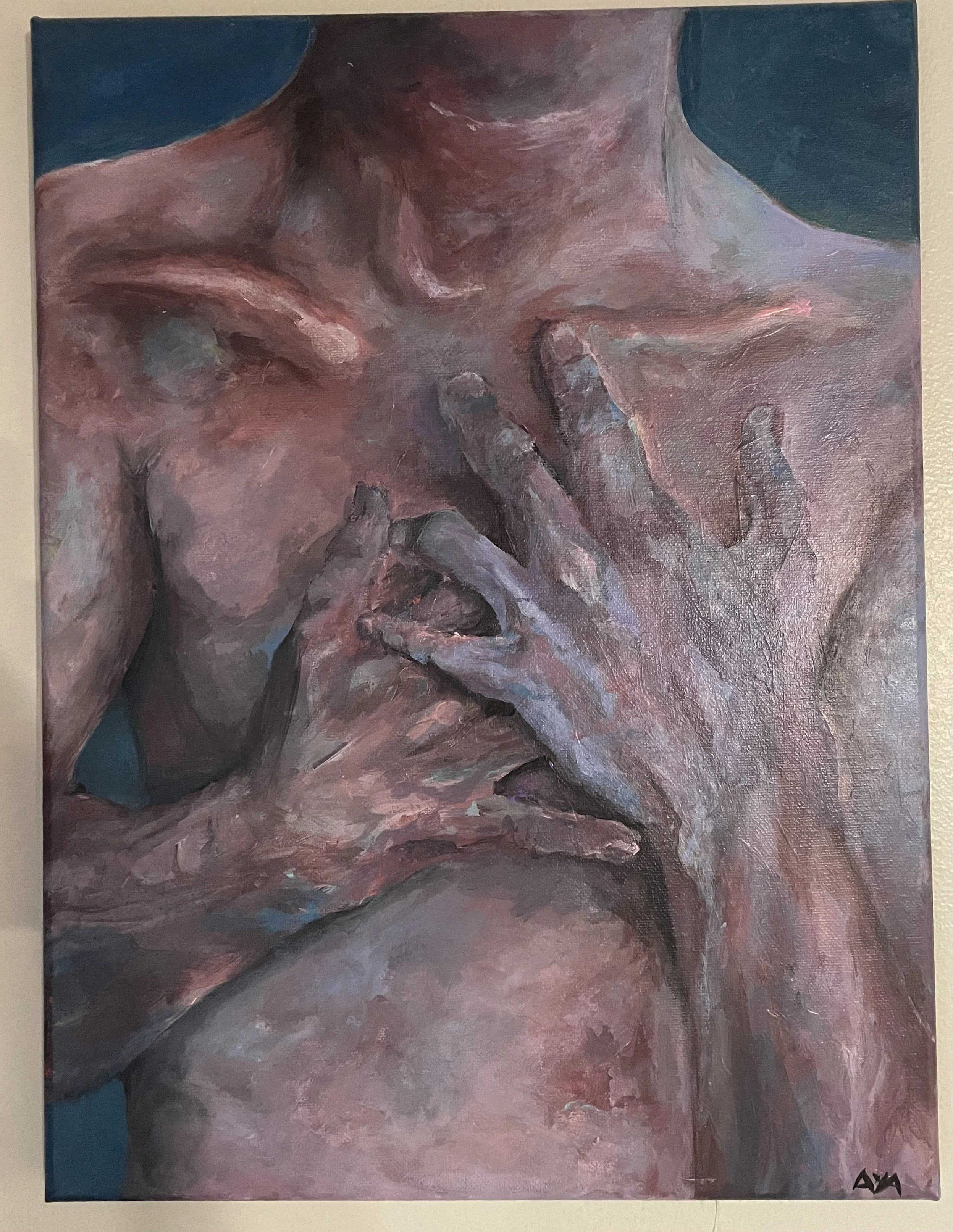
Heart ache By Aya Sbeiti
The piece “Heart Ache” features a body clutching their chest, more specifically their heart. It symbolizes the grief of the world being held together by fragile hands who now only know to clutch their heart as if stricken by pain. The colors of the scene are muted with hints of color from the veins and the supple skin, with callouses on the fingers proving hardship.
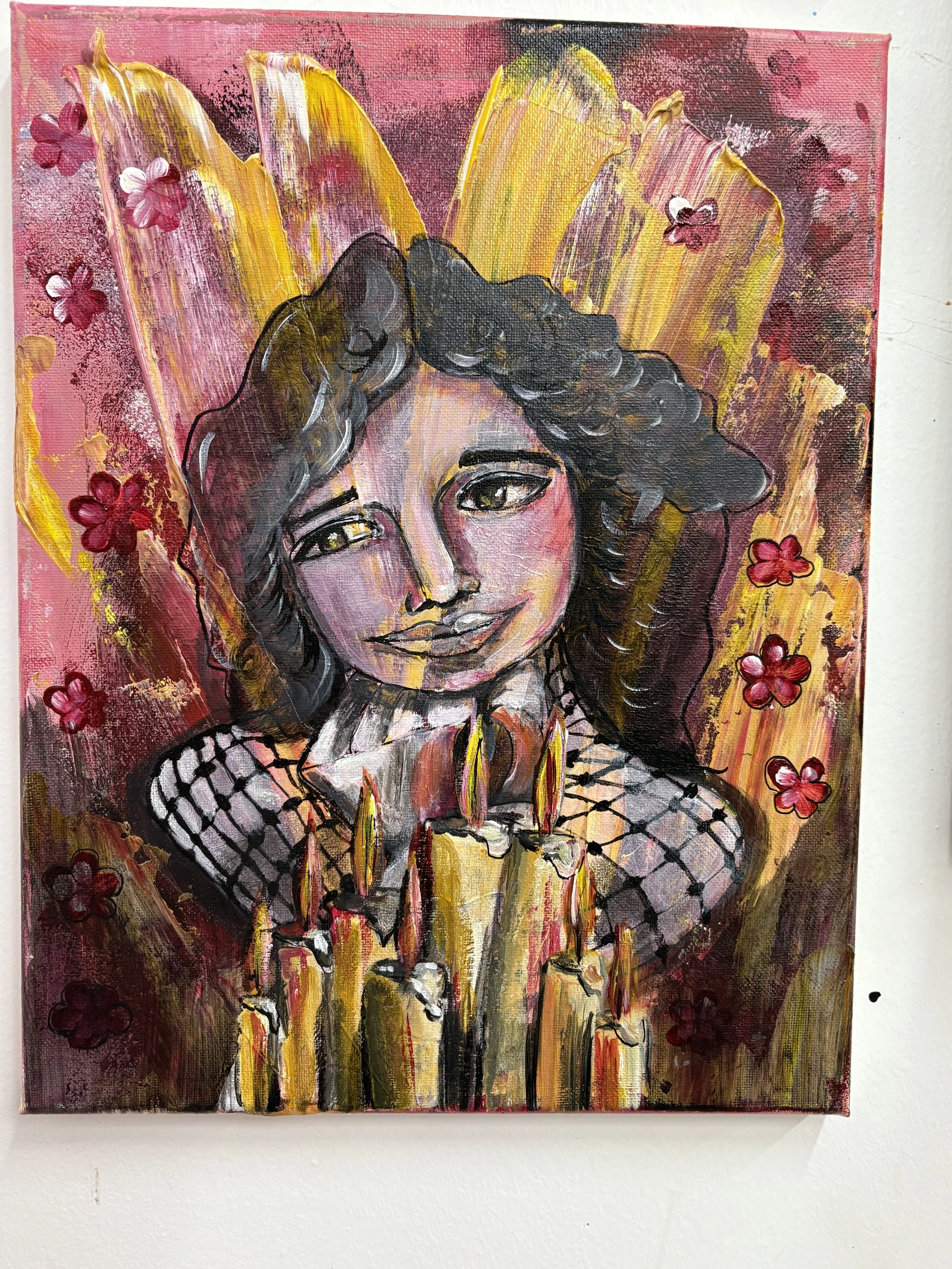
بصيرة by Marwa Hachem
فتاة فلسطينية عندها بصيرة رغم القتل و الدمار .. الانسانية رح تنتصر
Translation: “Insight” by Marwa Hachem
A Palestinian girl who possesses insight despite the killing and destruction… humanity will prevail.
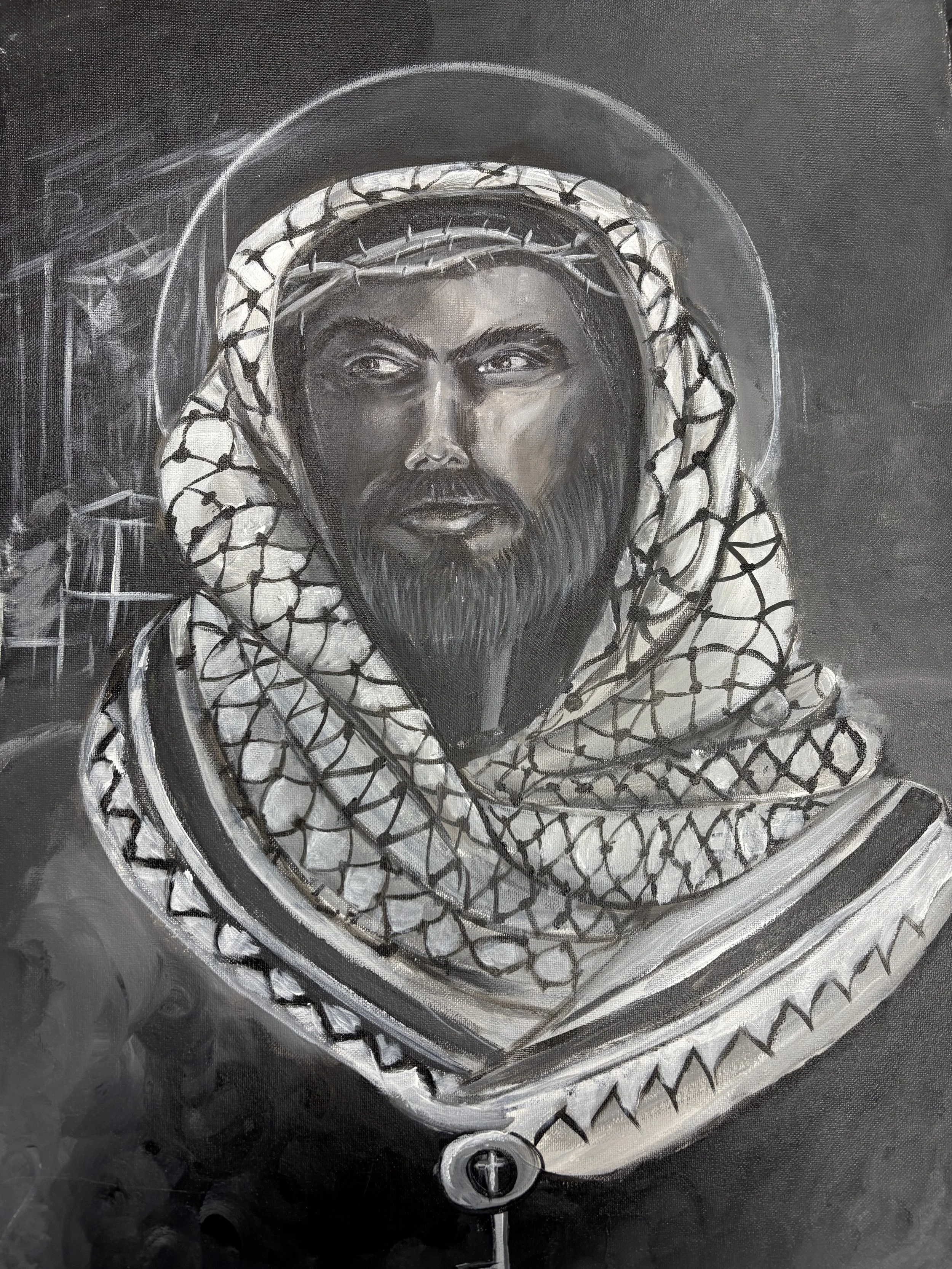
Jesus is Palestinian by Marwa Hachem
المسيح من فلسطين
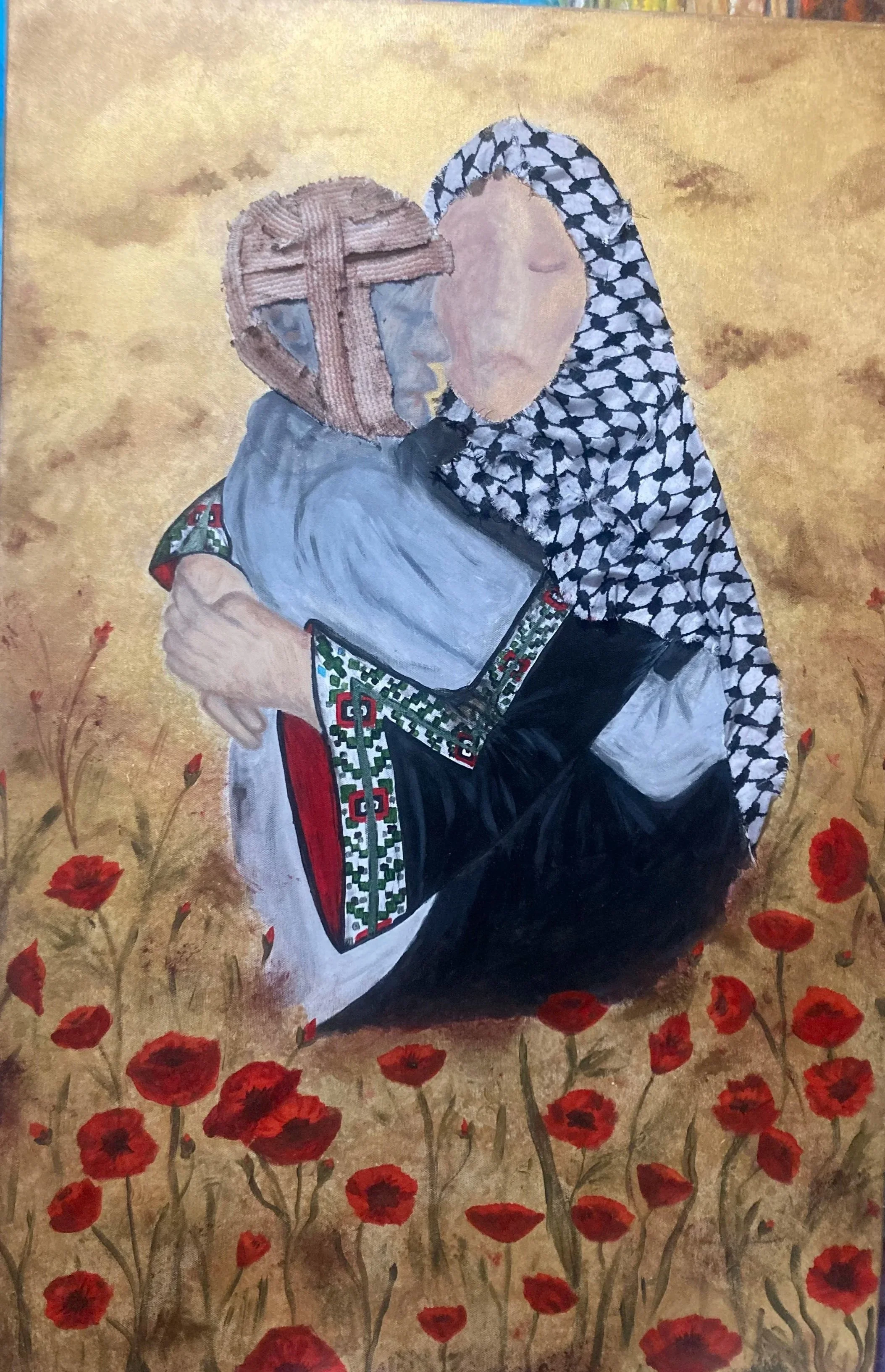
Eternal Embrace by Yusra
“ In God, we return to him in the state of the last moments spent on earth. This man, unknown name, died in the arms of his wife. In Gaza, real cinematic endings are portrayed daily, sadly, heart wrenching, savagely, barbarically, lovingly, portrayed.” Yusra A
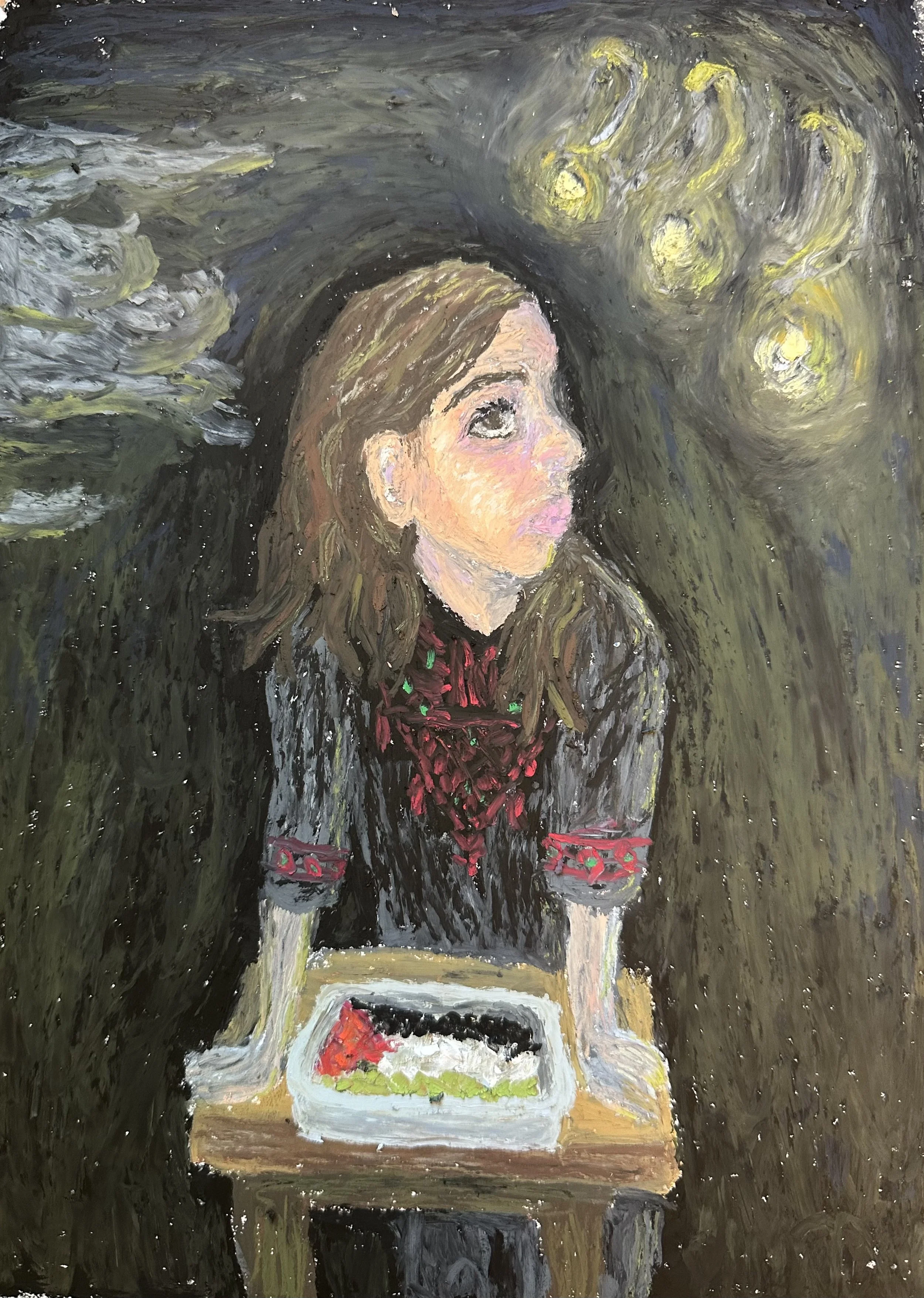
Renad from Gaza: I want to go back to school. by Chris DiScenza
This piece is based on Renad from Gaza who shares her love of cooking by creating videos of her favorite recipes even as ingredients become more scarce.
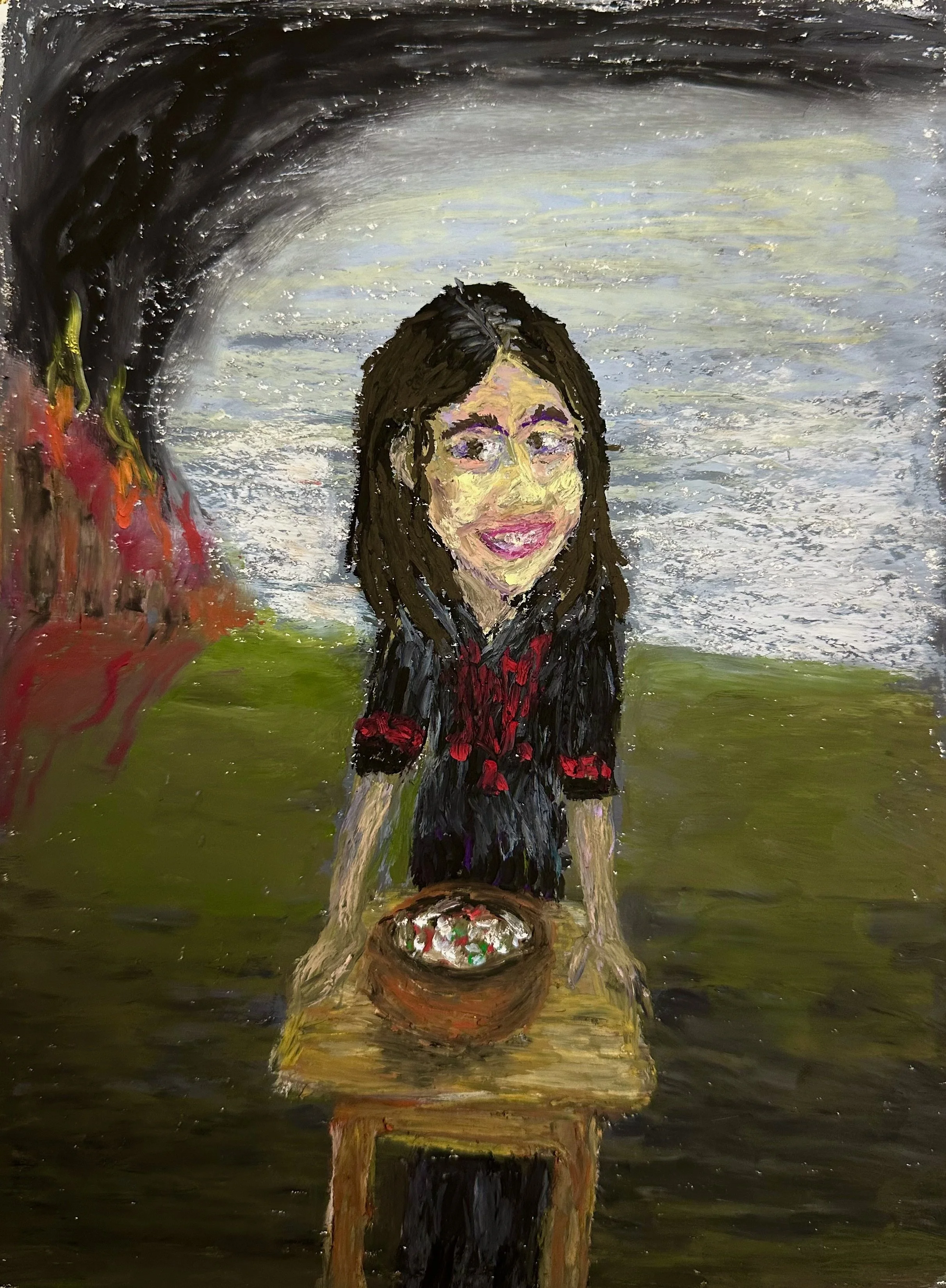
Renad from Gaza: I want to be a child again. by Chris DiScenza
This is the first piece in my series based on Renad from Gaza who shares her love of cooking by creating videos of her favorite recipes even as ingredients become more scarce.
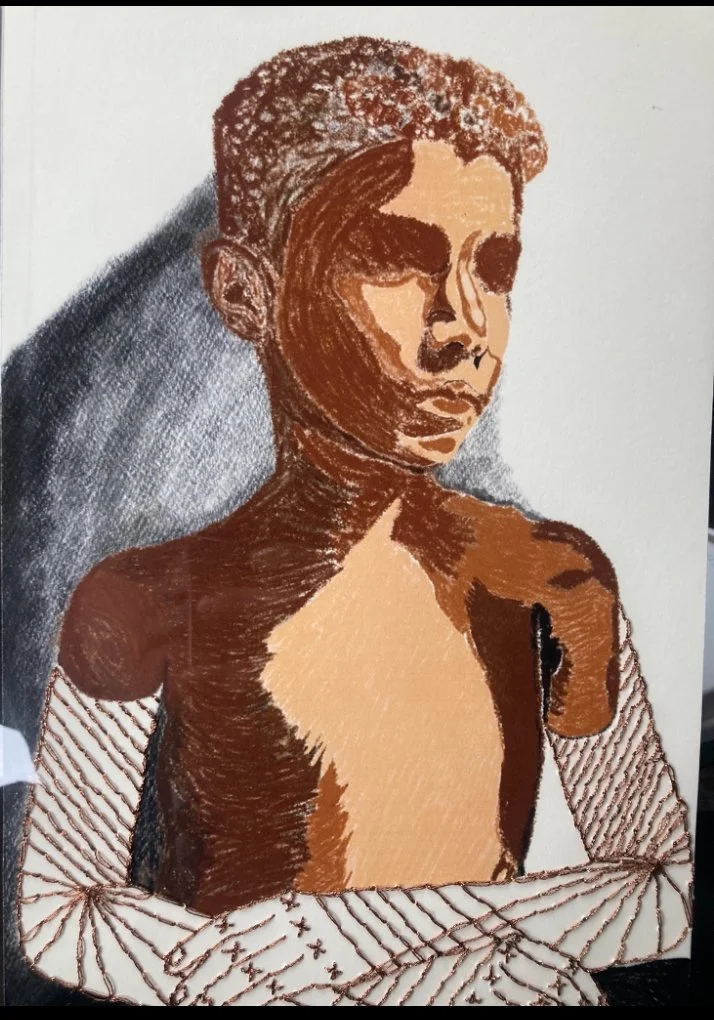
A Hug for Mahmoud Ajjour by Liane Al Ghusain
The children of Gaza live with scars and burns, both visible and invisible. They are robbed of their childhoods, orphaned of their parents, stripped of their dignity, and cleaved from their limbs. Gaza holds the world’s largest population of child amputees—up to 11,000, according to on-the-ground medical reports compiled by the Institute for Palestine Studies (2024). Mahmoud Ajjour, illustrated here, is one of them. He lost both his arms in an Israeli air strike in March 2024. The original photograph that inspired this illustration, taken by Palestinian photographer Samar Abu Elouf, won the 2025 World Press Photo of the Year award. In an interview, Mahmoud expressed his longing: “How will I be able to hug you?”—a question he asked his mother upon realizing the permanence of his injuries. This genocide feels endless, but it will one day end. Then our work will begin: to stitch a future from threads of grief and resistance, to tend to wounds both seen and unseen, to rock trauma into a deep, peaceful sleep. The metallic embroidery in these arms is a promise—that what has been taken will be remembered, and that dignity and love can eclipse even the heaviest loss.
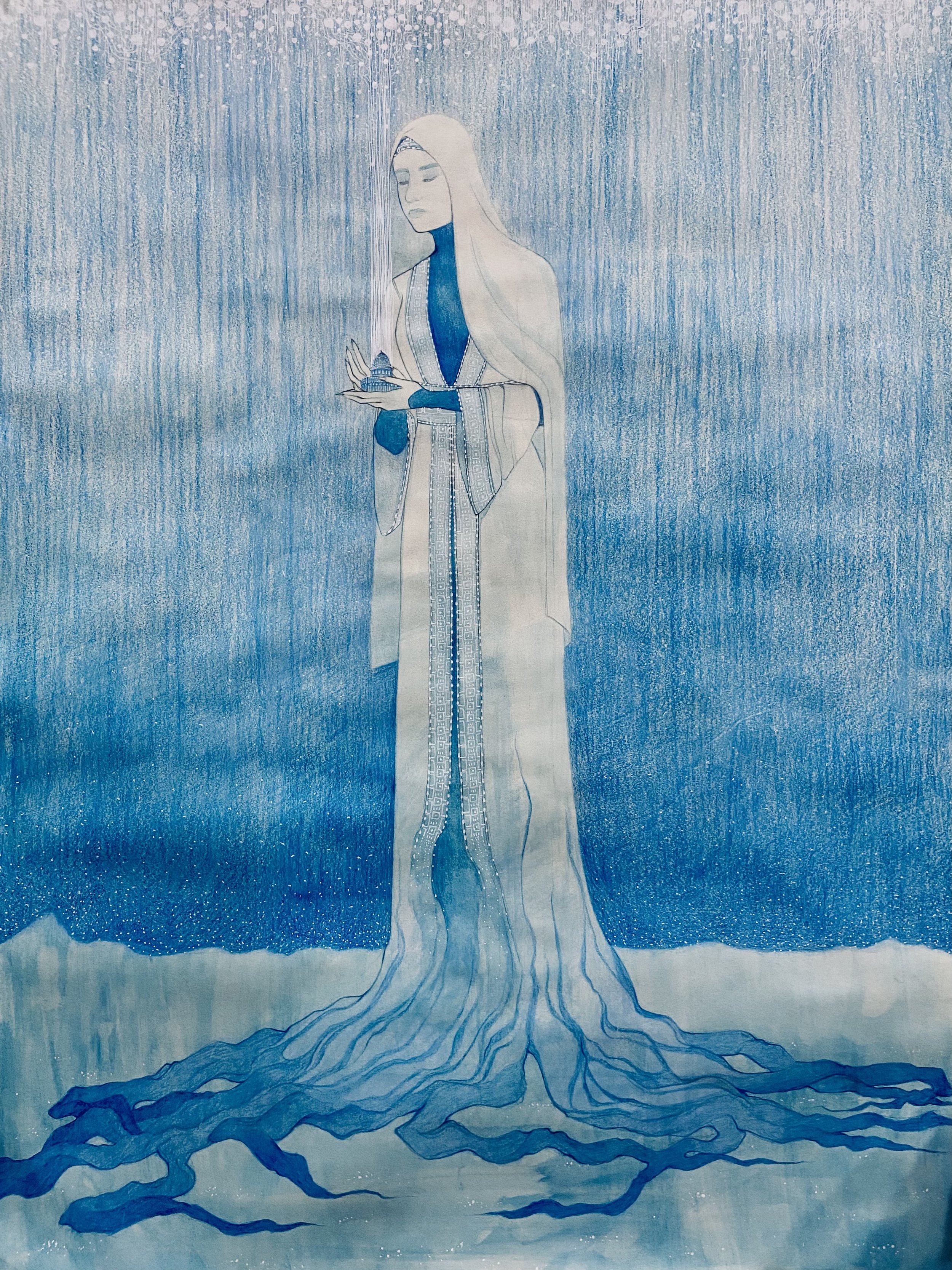
Roots by Noor Albahrani
This artwork was created both as an act of mourning the Palestinian martyrs and hope for the future. It also acknowledges the religious and cultural significance of Palestine, signifying that the roots grown in the land can never be torn out.
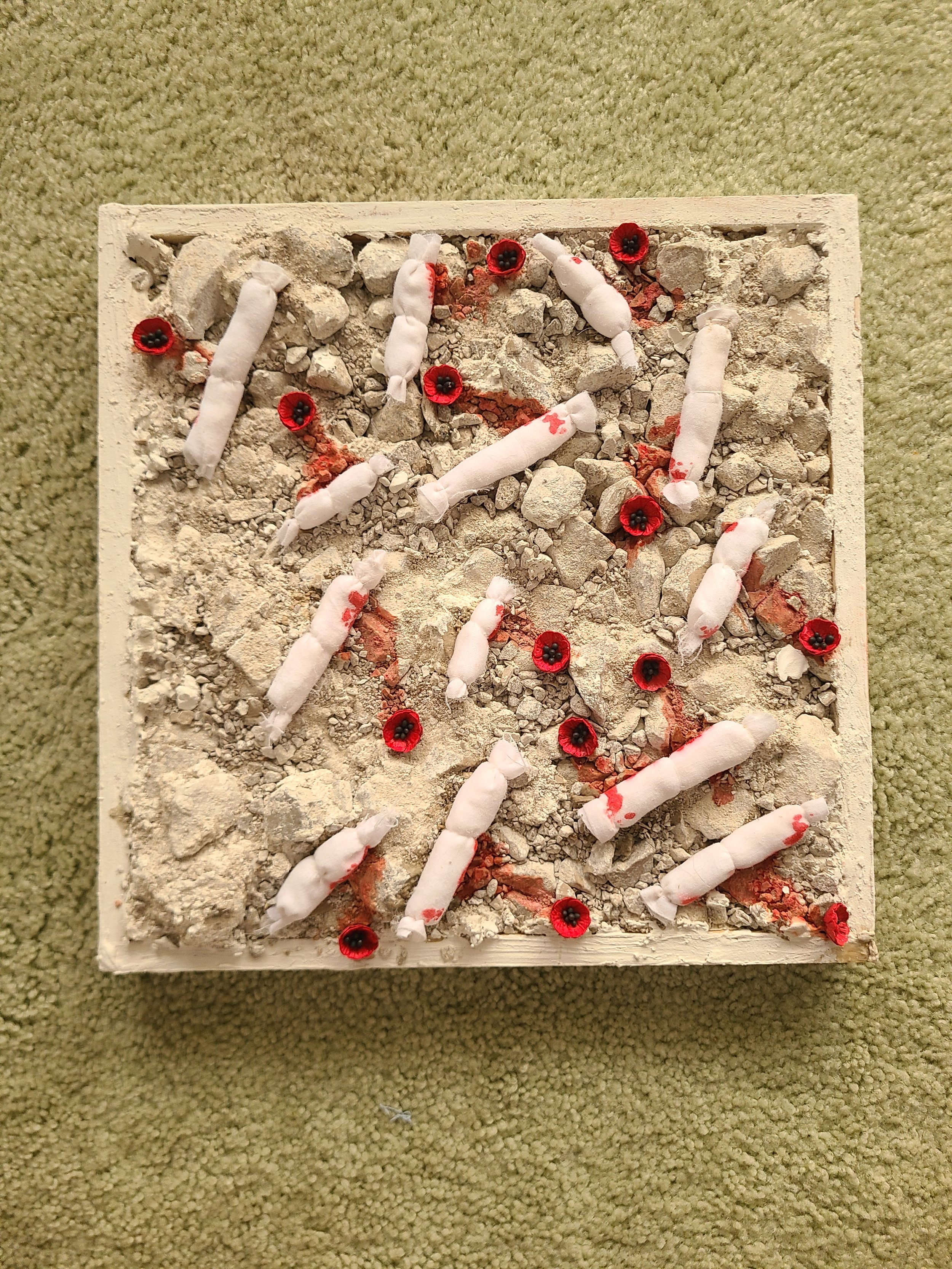
Untitled by Emily
This piece is a meditation on grief, resistance, and remembrance. Created in response to the ongoing genocide in Gaza, the work speaks to the deep human cost of war and the resilience that grows even in its aftermath. The shrouded forms, wrapped in white and laid across rubble and dust, represent the innocent lives lost—bodies that bear witness to a collective tragedy scattered among broken ground that no longer shelters life. And yet, from this blood-soaked soil, red poppies emerge: fragile symbols of remembrance, defiance, and the persistence of life. The poppy here reclaims its place in a different, urgent narrative. This is not only a piece about mourning, but about memory and resistance. The martyrs of Gaza are not forgotten. Their blood nourishes the conscience of the world, calling for justice, calling for an end. Through this work, I mourn with Gaza. I remember with Gaza. And I refuse to look away.
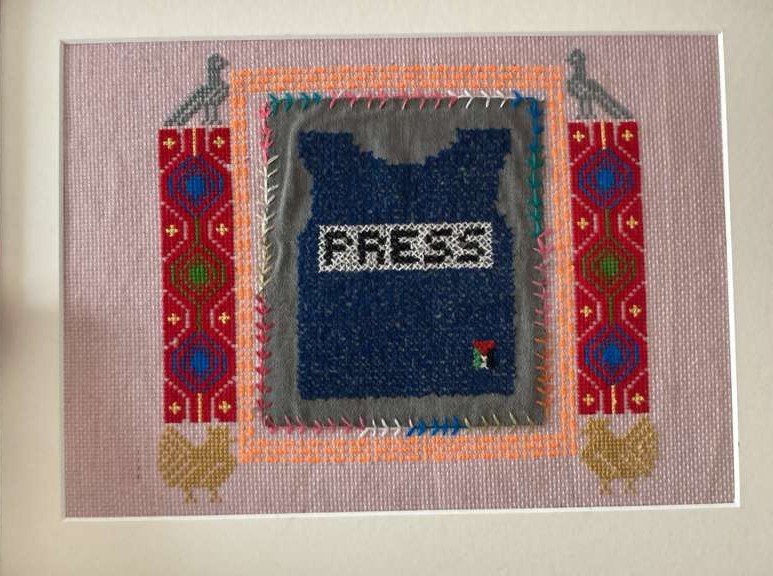
The Vest by Laura Witkowski
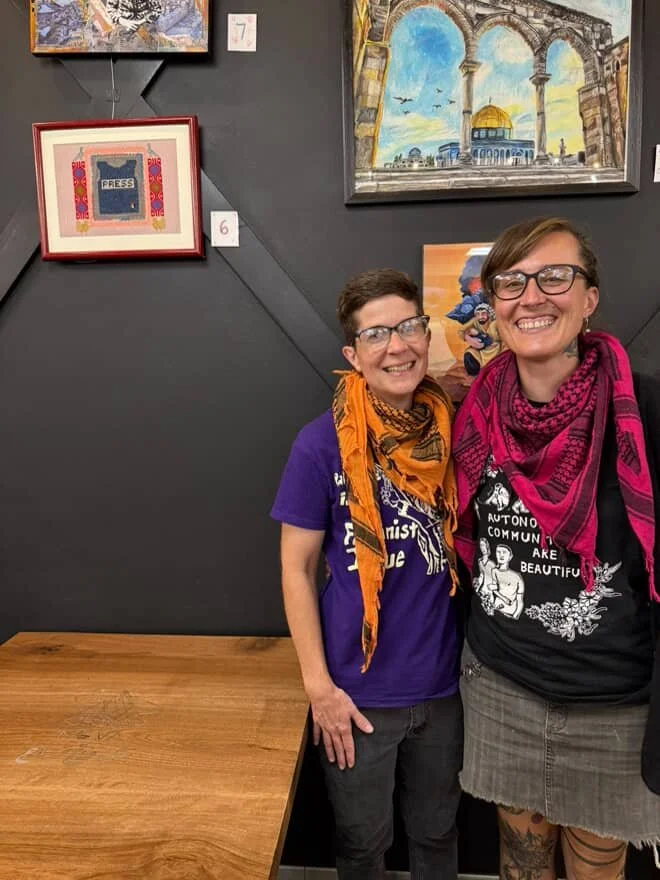
I made this piece to mourn the record number of Palestinian journalists being systematically murdered by Israel for daring to show and tell the truth. All while legacy journalists and media have stayed shamefully silent and fully complicit.
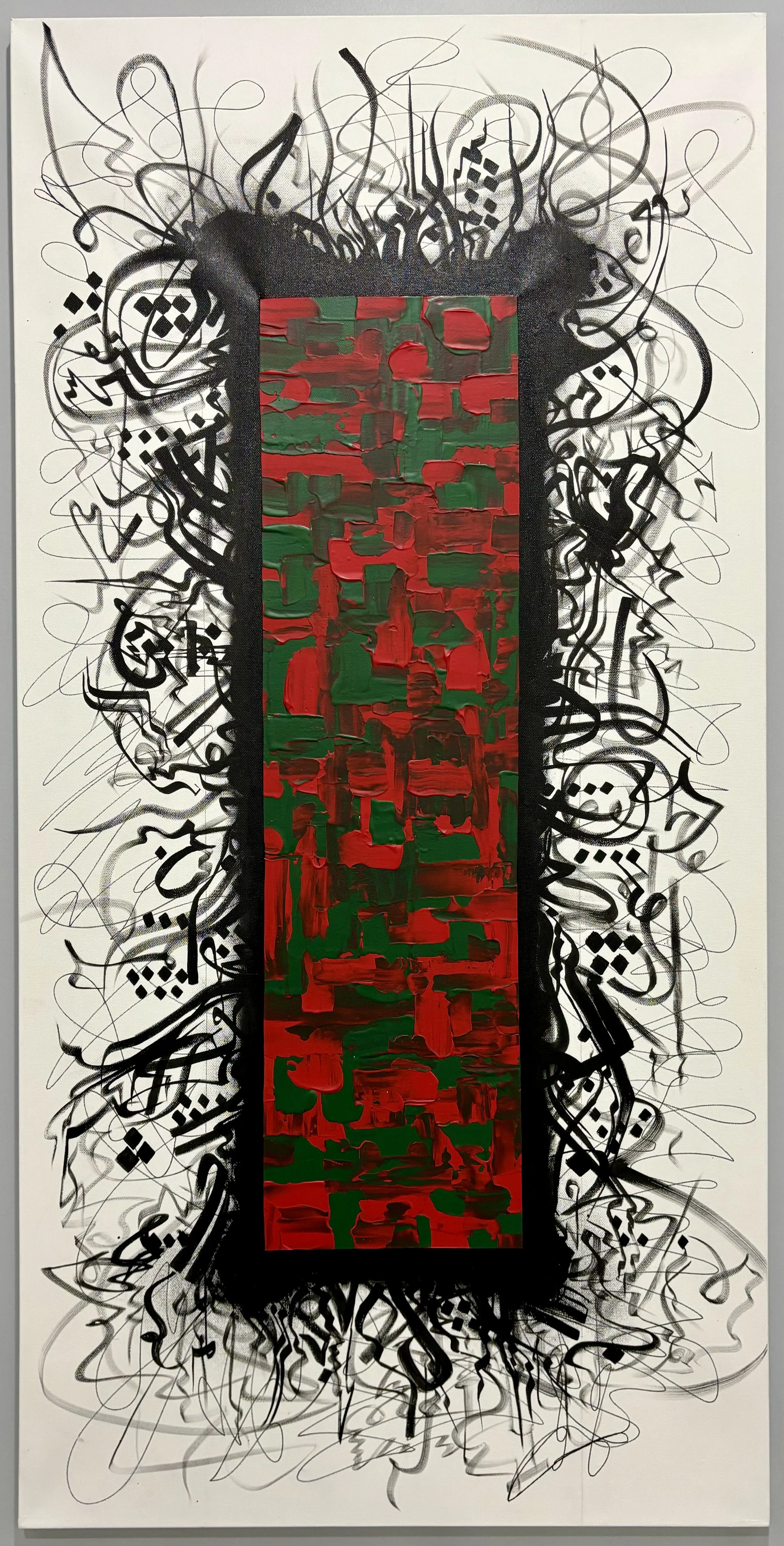
Missing Verse by Sahar Chamseddine
Everything once used to be held together in one place is now spreading from unknown. It speaks in sense of how we use our voice but majority of the times we are being silenced. We become fragile once it’s hungers our bodies because we have nothing left to say and no energy to stand. The center reflects on how a village was once held people, traditions, connections, and communities. The Arab symbols around the center reflects on how the village is taken from us. We are now separated, lost, and damaged.
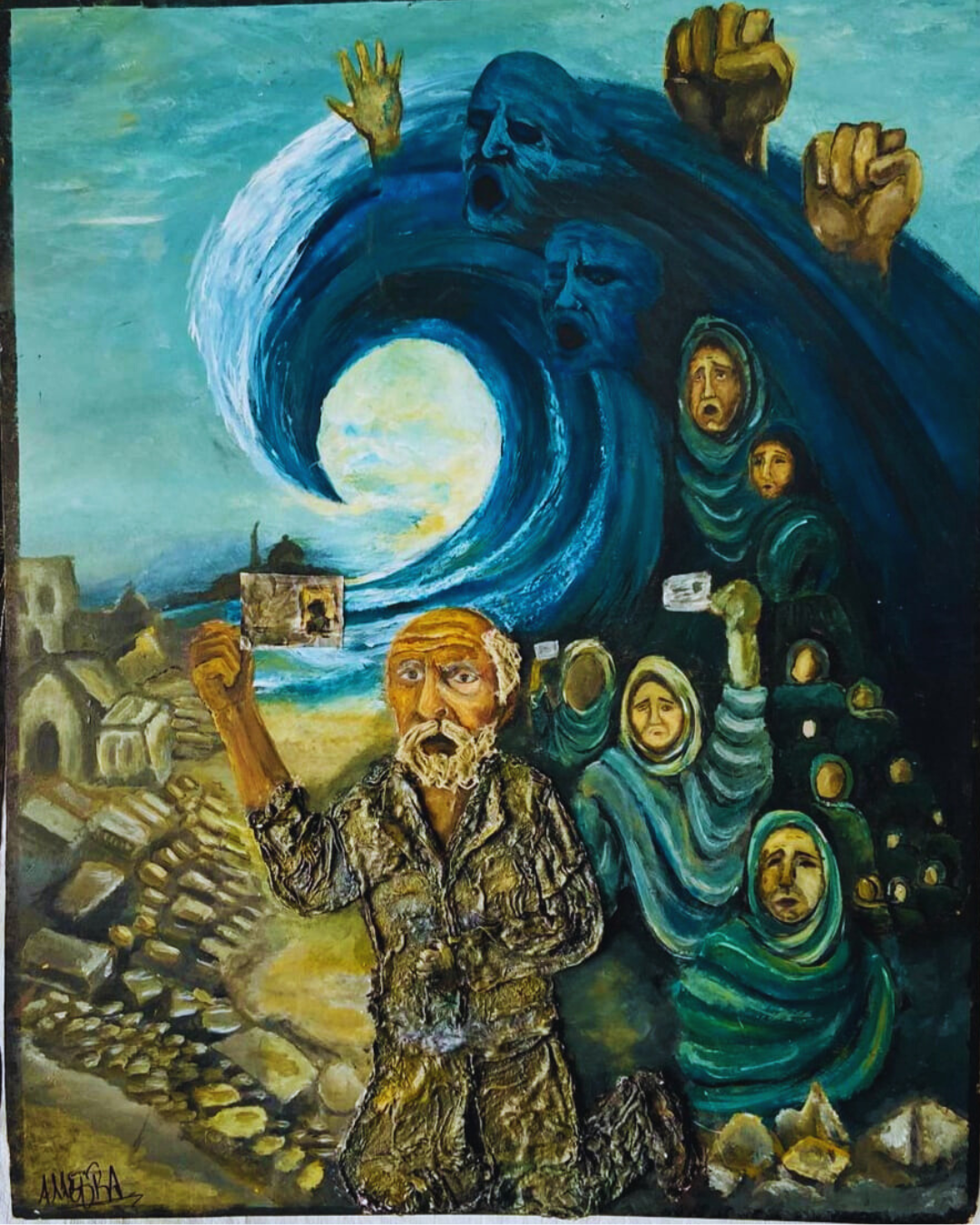
طوفان الأقصى by Ameera Ayaad
لوحة طوفان الأقصى العمل لا يرتكز فقط على الجانب الفني، بل يحمل رسالة قوية تتحدث عن الهوية، اللجوء، المعاناة الجماعية، والغضب المكبوت، والموجة التي تُشكّل من وجوه وأيادٍ مرفوعة تمثل الغضب الشعبي أو الثورة أو الصرخة الجماعية
Translation: Al Aqsa Flood By Ameera Ayaad
The painting “Al-Aqsa Flood” is not based solely on its artistic dimension; it carries a powerful message that speaks about identity, displacement, collective suffering, and suppressed anger. The wave formed from faces and raised hands represents popular rage, revolution, or a collective cry.
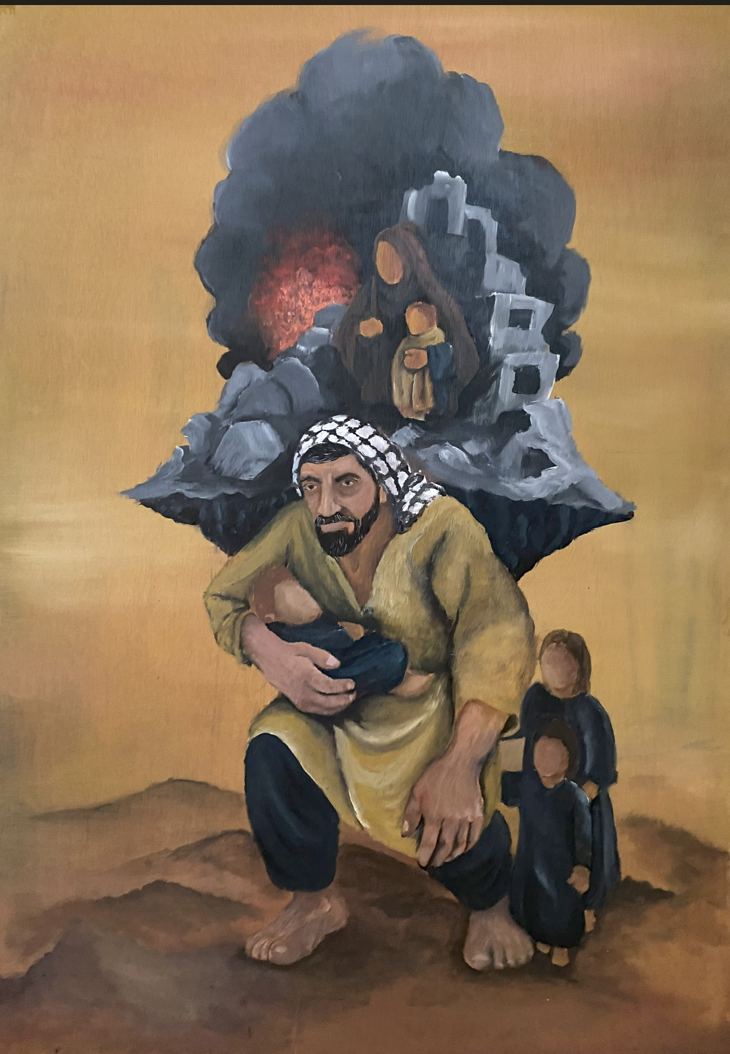
ثِقل النجاة by Yahya Sameer
النجاة في غزة ليست خلاصًا، بل حملٌ ثقيل فوق الأكتاف. العمل يصوّر كيف تصبح الحياة عبئًا في زمن الحرب، وكيف يحتاج البقاء لصبر يفوق قدرة الإنسان وتحمّل لا يُعقَل.
Translation:
Heavy Survival by
Survival in Gaza is not a deliverance, but a heavy burden upon the shoulders. The work portrays how life becomes a weight in times of war, and how staying alive requires a patience beyond human capacity and an endurance that defies reason.